📱 Please feel free to contact us at any time, phone/WeChat:15913439760 Address: No. 37 Guangfu Avenue, Xiaolan Town, Zhongshan City, Guangdong Province

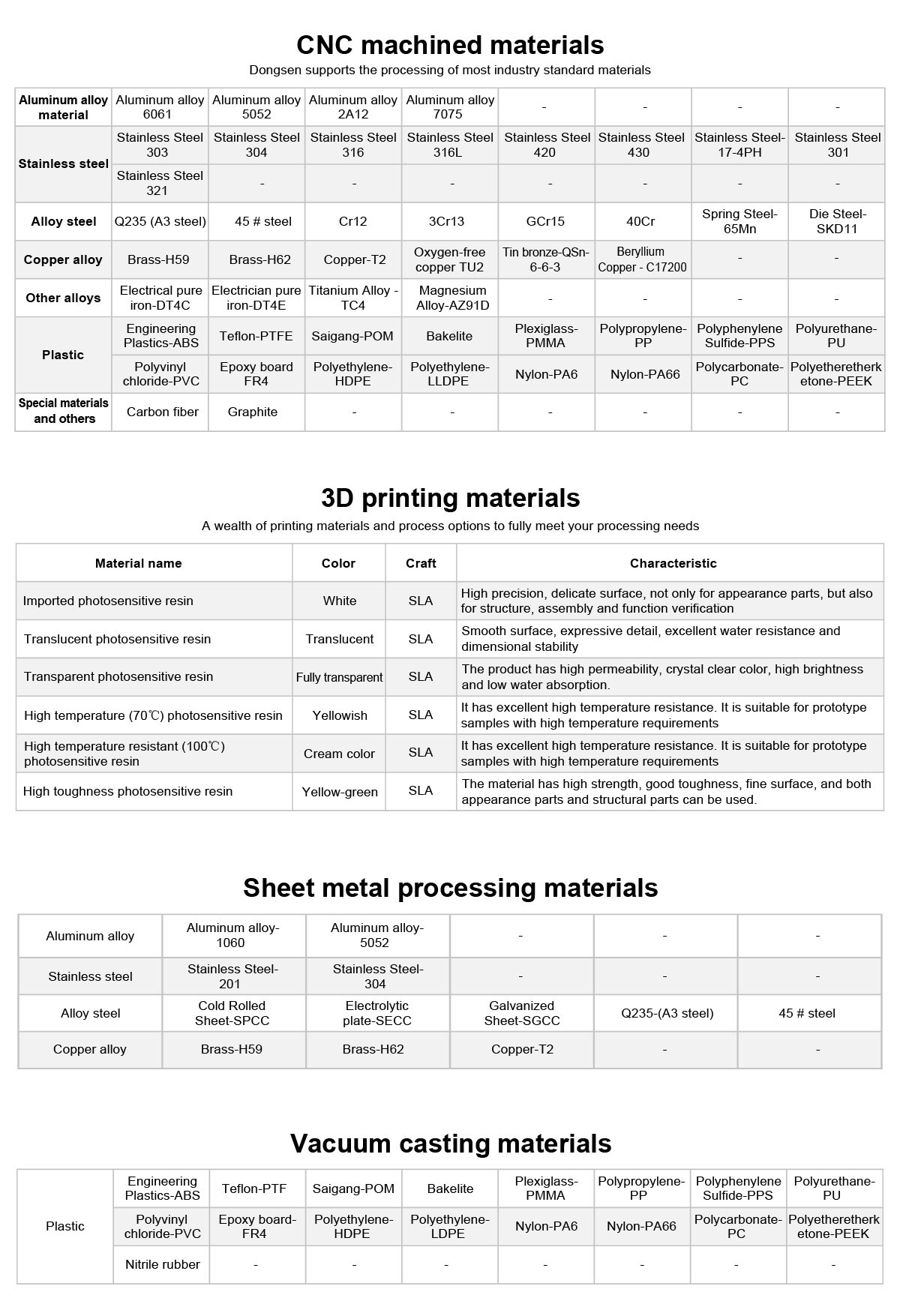
Whether it's plastic or metal, at Dongsen, you can freely choose according to your unique requirements.
21. Zinc alloy (zinc alloy die-casting)
Zinc alloy is an alloy composed of other elements based on zinc. The commonly added alloying elements include low-temperature zinc alloys such as aluminum, copper, magnesium, cadmium, lead, titanium, etc. Zinc alloy has a low melting point, good fluidity, is easy to weld, solder, and process plastics, is corrosion-resistant in the atmosphere, and residual waste is easy to recycle and remelt; However, the creep strength is low and it is prone to size changes due to natural aging. Prepared by melting, die-casting, or pressure processing. According to the manufacturing process, it can be divided into cast zinc alloy and deformed zinc alloy. The main added elements of zinc alloy are aluminum, copper, and magnesium. Zinc alloys can be divided into two types based on processing technology: deformed zinc alloys and cast zinc alloys. Casting zinc alloy has good fluidity and corrosion resistance, suitable for die-casting instruments and automotive parts shells, etc
22.H59 brass copper (CNC machining 〡 sheet metal machining)
H59 brass is the cheapest brass, with high strength, high hardness, and good plasticity, but it can still withstand pressure processing well at high temperatures, with average corrosion resistance and other properties similar to H62.
23.H62 brass copper (CNC machining 〡 sheet metal machining)
Ordinary brass has good mechanical properties, good hot plasticity, strong cold plasticity, good machinability, easy brazing and welding, corrosion resistance, but is prone to corrosion cracking. In addition, it is a common brass variety widely used due to its low price. H62 (i.e. four or six brass). At room temperature, beta phase is much harder than alpha phase, making it suitable for parts that can withstand higher loads.
24. T2 copper (CNC machining 〡 sheet metal machining)
It has good conductivity, thermal conductivity, corrosion resistance, and processability, and can be welded and brazed. It contains fewer impurities that reduce conductivity and thermal conductivity, and trace amounts of oxygen have little effect on conductivity, thermal conductivity, and processing performance, but can easily cause "hydrogen disease".
25. T3 copper (CNC machining 〡 sheet metal machining)
T3 copper has good conductivity, thermal conductivity, corrosion resistance, and processability, and can be welded and brazed. However, it contains more impurities that reduce conductivity and thermal conductivity, with oxygen content higher than T2, making it more prone to "hydrogen sickness" and unable to be processed (annealed, welded, etc.) and used in reducing atmospheres at high temperatures (such as>370 ° C).
26. Electric Pure Iron DT4E (Electric Pure Iron CNC Machining)
Industrial pure iron is mainly used for electromagnetic relays, iron core pure iron, soft magnetic pure iron, magnetic powder clutch pure iron, electronic lock pure iron, electric vehicle piston pure iron, magnetic shielding pure iron strip, aviation instruments, military pure iron, galvanized pot pure iron medium thick plate, electronic component pure iron sheet, solenoid valve, magnetic separator pure iron, non hairline pure iron, electric tube pure iron, and easy to cut electric pure iron.
27. ABS Engineering Plastic ABS (3D Printing 〡 Injection Molding 〡 Prototype Production 〡 CNC Machining)
ABS resin is one of the five major synthetic resins. It has excellent impact resistance, heat resistance, low temperature resistance, chemical resistance, and electrical performance. It also has the characteristics of easy processing, stable product size, and good surface glossiness. It's easy to draw. It can also be used for secondary processing, such as surface metallization, electroplating, welding, hot pressing, and bonding. Widely used in industrial fields such as machinery, automobiles, electronic appliances, instruments and meters, textiles, and construction. Widely used thermoplastic engineering plastics. ABS is usually a light yellow or milky white granular amorphous resin. ABS is one of the most widely used engineering plastics.
28. Nylon PA6 Nylon (3D printing, injection molding, prototype design, CNC machining)
This material has the most superior comprehensive performance, including mechanical strength, stiffness, toughness, mechanical shock absorption, and wear resistance. These characteristics, combined with good electrical insulation and chemical resistance, make nylon 6 a "universal" material for manufacturing mechanical structural components and repairable parts.
29. Nylon PA66 Nylon (3D printing, injection molding, prototype production, CNC machining)
Compared with nylon 6, it has better mechanical strength, stiffness, heat and wear resistance, and creep resistance, but its impact strength and mechanical shock absorption performance are reduced, making it very suitable for automatic lathe machining. PA66 is more widely used in the automotive industry, instrument casings, and other products that require impact resistance and high strength.
30. Nylon PA12 Nylon (3D printing 〡 injection 〡 prototype 〡 CNC machining)
The scientific name of PA12 is poly laurolactam, also known as nylon 12. The basic raw material for its polymerization is butadiene, which can rely on petrochemical products. It is a semi crystalline thermoplastic material. Its properties are similar to PA11, but its crystal structure is different. PA12 is a good electrical insulator that, like other polyamides, does not affect its insulation performance due to moisture. It has good impact resistance and chemical stability. There are many improved varieties of PA12 in terms of plasticization and enhanced performance. Compared with PA6 and PA66, these materials have lower melting points and densities, and have very high moisture regain. PA12 has no resistance to strong oxidizing acids. Typical applications of nylon 12 include commercial equipment such as water meters, cable conduits, mechanical camshafts, sliding mechanisms, photovoltaic backplates, and bearings.
31. PVC (PVC injection molding, first plate production, CNC machining)
Polyvinyl chloride, abbreviated as PVC, is an initiator of vinyl chloride monomer (VCM) in peroxides, azo compounds, and other initiators; Or through the mechanism of free radical polymerization under the action of light and heat polymerization of polymers. Vinyl chloride homopolymers and vinyl chloride copolymers are collectively referred to as vinyl chloride resins. Polyvinyl chloride was once the world's largest general-purpose plastic with a wide range of applications. It is widely used in building materials, industrial products, general merchandise, floor leather, floor tiles, artificial leather, pipes, wires and cables, packaging films, bottles, foam materials, sealing materials, fibers, etc.
32. POM Saigang (POM injection molding, prototype production, CNC machining)
POM is a tough and elastic material that exhibits good creep resistance, geometric stability, and impact resistance even at low temperatures. Polyoxymethylene has two types of materials: homopolymers and copolymers. Homopolymer materials have good ductility and fatigue strength, but are not easy to process. Polymer materials have good thermal and chemical stability, and are easy to process. Both homopolymer materials and copolymer materials are crystalline materials that are not easily able to absorb moisture. The high crystallinity of POM results in a relatively high shrinkage rate, which can be as high as 2% to 3.5%. The shrinkage rate of various reinforcing materials varies. POM has a very low coefficient of friction and good geometric stability, making it particularly suitable for manufacturing gears and bearings. Due to its high temperature resistance, it is also used in pipeline equipment (valves, pump casings), lawn equipment, etc. Audio devices such as video recorders, CDs, LDs, MD players, radios, headphones, and stereos; OA equipment such as printers, keyboards, and CD-ROM drives; Household appliances such as washing machines, dryers, and hair dryers; Automotive components such as handles, mirrors, and engine compartments, precision parts such as cameras and clocks, as well as molding materials for building materials, toys such as game consoles and stationery.
33. PPS (PPS prototype production 〡 CNC machining)
PPS plastic (polyphenylene sulfide) is a thermoplastic special engineering plastic with excellent comprehensive performance. Its outstanding features are high temperature resistance, corrosion resistance, and excellent mechanical properties. Excellent electrical insulation (especially high-frequency insulation), white hard and brittle, metallic noise when dropped on the ground, second only to organic glass in terms of light transmittance, water-resistant coloring, and good chemical stability. It has excellent flame retardancy and is a non flammable plastic. The strength is average and the stiffness is good, but the quality is brittle and prone to stress embrittlement; It is not resistant to organic solvents such as benzene and gasoline; Long term use temperature can reach 260 degrees, stable in air or nitrogen at 400 degrees. By adding glass fiber or other reinforcing materials for modification, the impact strength can be greatly improved, and the heat resistance and other mechanical properties can also be enhanced. The density can be increased to 1.6-1.9, and the molding shrinkage rate can be reduced to 0.15-0.25%. In the production of heat-resistant parts, insulation parts, chemical equipment, optical equipment and other components.
34. PEEK (PEEK prototype 〡 CNC machining)
Polyether ether ketone (PEEK) resin is a special engineering plastic with excellent performance. Compared with other special engineering plastics, it has more significant advantages. Resistant to high temperatures of 260 degrees, with excellent mechanical properties, good self-lubricating properties, chemical corrosion resistance, flame retardancy, peel resistance, wear resistance, not resistant to strong nitric acid, concentrated sulfuric acid, radiation resistance, and super strong mechanical properties. It can be used in high-end machinery, nuclear engineering, aviation and other technologies.
35. Polytetrafluoroethylene (PTFE) (PTFE prototype production and CNC machining)
Polytetrafluoroethylene, abbreviated as PTFE (commonly known as "Plastic King, Hala"), is a brand name of Teflon ®, In China, due to pronunciation reasons, the "Teflon" trademark is also known as "Special". Fulong "," Teflon "," polytetrafluoroethylene "," PTFE "," Teflon ", etc. are all transliterations of" Teflon ". Products made from this material are commonly referred to as' non stick coatings'; A synthetic polymer material that uses fluorine to replace all hydrogen atoms in polyethylene. This material has the characteristics of acid and alkali resistance and resistance to various organic solvents, and is almost insoluble in all solvents. Meanwhile, polytetrafluoroethylene has the characteristic of high temperature resistance and extremely low friction coefficient, which can be used for lubrication and also becomes an ideal coating for non stick pans and inner layers of water pipes.
36. Rubber wood (rubber wood prototype 〡 CNC machining)
Jiaomu is the first plastic to be put into industrial production. It has high mechanical strength, good insulation, heat resistance, and corrosion resistance, so it is often used to manufacture electrical materials such as switches, lamp sockets, headphones, telephone housings, instrument housings, etc., hence the name "phenolic resin".
37. Photosensitive resin (photosensitive resin 3D printing)
The material used for photopolymerization rapid prototyping is liquid photopolymerization resin or liquid photosensitive resin, mainly composed of oligomers, photoinitiators, and diluents. In the past two years, photosensitive resins have been applied in the emerging industry of 3D printing and have been favored and valued by the industry due to their excellent properties.
38. Organic glass PMMA (acrylic) (organic glass injection molding, prototype production, CNC machining)
Organic glass (polymethyl methacrylate) is a popular name, abbreviated as PMMA. The chemical name for this transparent polymer material is polymethyl methacrylate, which is a polymer compound formed by the polymerization of methyl methacrylate. It is an important thermoplastic developed in the early stages. Organic glass is divided into four types: colorless transparent, colored transparent, pearl like, and embossed organic glass. Organic glass is commonly known as acrylic, Zhongxuan acrylic, or acrylic. Organic glass has the advantages of good transparency, good chemical stability, good mechanical and weather resistance, easy dyeing, easy processing, and beautiful appearance. Organic glass is also known as gelatin glass, acrylic acid, etc. This material is widely used in the production of advertising light boxes, nameplates, etc.
39. PET (PET injection molding, prototype production, CNC machining)
Polyethylene terephthalate is the most important thermoplastic polyester variety, commonly known as polyester resin. It is prepared by exchanging dimethyl terephthalate with ethylene glycol ester, or by esterifying terephthalic acid with ethylene glycol to synthesize hydroxyethyl terephthalate, and then conducting a condensation reaction. Together with PBT, they are collectively referred to as thermoplastic polyester or saturated polyester. It has excellent physical and mechanical properties over a wide temperature range, with a long-term use temperature of up to 120 ° C and excellent electrical insulation performance. Even at high temperatures and frequencies, its electrical performance is still good, but its corona resistance is poor, and it has good creep resistance, fatigue resistance, friction resistance, and dimensional stability.
40. PBT (injection molding, prototype production, CNC machining)
Polybutylene terephthalate, also known as polybutylene terephthalate (PBT) in English, belongs to the polyester series and is composed of 1.4bt butanediol (1.4-butanediol) and terephthalic acid (PTA) or terephthalic acid. A milky white semi transparent to opaque crystalline thermoplastic polyester resin made by condensation of methyl formate (DMT) using a mixing process. Along with PET, it is collectively referred to as thermoplastic polyester or saturated polyester. Household appliances (food processing blades, vacuum cleaner components, electric fans, hair dryer housings, coffee utensils, etc.), electrical components (switches, motor housings, fuse boxes, computer keyboard keys, etc.), automotive industry (radiator grilles, etc.), body panels, wheel covers, door and window components, etc.
41. PC (PC injection molding, prototype production, CNC machining)
Polycarbonate (PC) is a high molecular weight polymer that contains carbonate groups in its molecular chain. According to the structure of ester groups, they can be classified into aliphatic, aromatic, and aliphatic aromatic types. Among them, the low mechanical properties of aliphatic and aliphatic aromatic polycarbonates limit their application in engineering plastics. The three major application areas of PC engineering plastics are glass assembly industry, automotive industry, and electronic and electrical industry, followed by industrial machinery components, optical discs, packaging, computers and other office equipment, healthcare, film, leisure and protective equipment, etc.
42. PP (PP injection molding, prototype production, CNC machining)
Polypropylene is a thermoplastic resin obtained by polymerizing propylene. The relative density is relatively small, only 0.89-0.91, making it one of the lightest plastic varieties. Due to its high crystallinity, this material has excellent surface stiffness and scratch resistance. PP does not have environmental stress cracking issues.
43. Polyurethane PU (polyurethane prototype production)
Polyurethane is a type of polymer with repeating - NHCOO - structural units in its main chain, abbreviated as PU in English. It includes various forms such as rigid polyurethane plastics, flexible polyurethane plastics, polyurethane elastomers, etc., and is divided into two categories: thermoplastic and thermosetting. Its raw materials are usually presented in a resin state.
44. Rubber (rubber prototype)
Rubber: A highly elastic polymer material with reversible deformation. It is elastic at room temperature and can undergo significant deformation under small external forces. After removing the external force, it can return to its original state. Rubber is a completely amorphous polymer with a low glass transition temperature (Tg) and typically larger molecular weights, exceeding several hundred thousand.